The original gas-powered Kia Stinger concluded its production run after 2023, but its gran turismo ethos has spurred development toward a high-performance electric successor frequently projected for 2027–2028 (internally codenamed GT1 and widely expected as the Kia EV8).
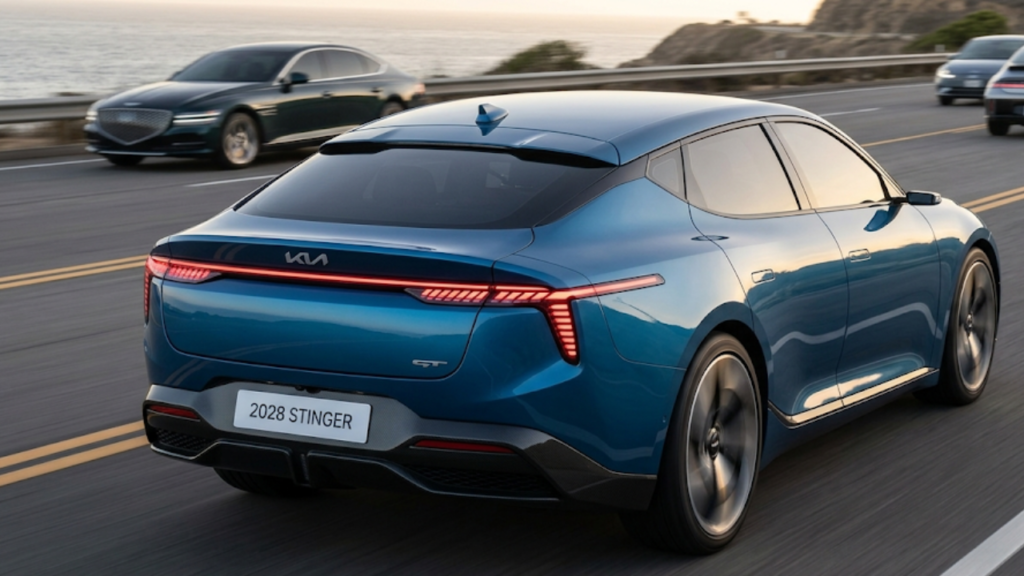
From Gas GT to Electric Flagship
When the Stinger launched for the 2018 model year under the engineering direction of Albert Biermann, it disrupted the premium sports sedan market by matching German benchmarks like the BMW 4 Series Gran Coupe and Audi S5 Sportback at a fraction of the cost.
While the internal combustion version was retired with the 2023 Tribute Edition, Kia’s high-performance fastback philosophy is returning in an all-electric halo model.
| Spec / Component | Original Stinger GT (Benchmark) | 2028 Next-Gen Successor (EV8 / GT1 Project) |
| Powertrain | 3.3L Twin-Turbo V6 (Gasoline) | Dual-Motor Electric AWD |
| Platform | Genesis RWD Architecture | Next-Gen Dedicated EV Architecture (eM) |
| Target Power | 368 hp / 376 lb-ft | Up to ~600+ hp (GT Variant) |
| 0–100 km/h (0–62 mph) | 4.7 – 4.9 seconds | ~3.0 – 3.3 seconds |
| Battery / Range | N/A (15.9 gal fuel tank) | ~113.2 kWh (~600–700 km / 370–435 miles target) |
| Architecture / Charging | Standard 12V | 800V Ultra-Fast Charging (10–80% in <18 min) |
Key Highlights of the Next-Gen Stinger Reimagining
- Next-Gen eM Architecture: Built on Hyundai Motor Group’s next-generation modular platform, providing improved battery efficiency, structural stiffness, and aerodynamic low-slung grand tourer proportions over typical crossover EV platforms.
- Gran Turismo Silhouette: Retaining the hallmark fastback liftback profile with an extended wheelbase, short front overhangs, and a functional rear hatch.
- True Track-Bred Dynamics: Utilizing electronic limited-slip differentials (e-LSD), adaptive damping, and simulated multi-gear shifting logic evolved from Hyundai N and Kia GT performance divisions.
- Driver-Centric Cockpit: Seamless digital displays integrated into a minimalist, wrap-around dash with sustainable materials, augmented-reality head-up display (AR-HUD), and Level 3 conditional autonomous driving capabilities.
Battery Specs
The Hyundai Motor Group (HMG) eM platform and its flagship application in the Kia GT1 project (EV8) mark a transition from the first-generation E-GMP architecture to an Integrated Modular Architecture (IMA) designed for greater scale, range, and high-performance output.
1. Hyundai Motor Group eM Platform Architecture
The eM platform is HMG’s next-generation passenger car EV dedicated architecture, replacing bespoke sub-segment architectures with a unified hardware-software backbone:
- Integrated Modular Architecture (IMA): Unlike the E-GMP platform where battery packs and drive units vary significantly across chassis types, IMA standardizes battery cell-to-pack formats and electric drive units (EDUs) across all vehicle segments.
- Cell-to-Chassis Integration: Eliminates module-level hardware to integrate pouch or prismatic cells directly into the floor structure, enhancing torsional rigidity while drastically lowering the overall vehicle center of gravity.
- Software-Defined Vehicle (SDV) Core: Centralized zonal electrical/electronic (E/E) architecture that consolidates dozens of ECUs into high-performance central compute units, natively supporting Over-The-Air (OTA) continuous updates and Level 3+ conditional autonomous driving.
- 800V Multi-Charging System: Retains the high-voltage ultra-fast DC charging capabilities of E-GMP, optimized for sustained thermal management under continuous high-load highway cruising and fast-charging cycles.
2. Kia GT1 (EV8) Powertrain Configurations
According to leaked technical specifications, the Kia GT1 will be offered across single- and dual-motor tiers, topping out with a dedicated GT performance setup:
| Trim Level | Configuration | Front Motor | Rear Motor | Total Power |
| Base RWD | Single Motor (Rear) | — | 160 kW (215 hp) | 160 kW (215 hp) |
| Mid-Tier AWD | Dual Motor (AWD) | 160 kW (215 hp) | 160 kW (215 hp) | 320 kW (429 hp) |
| GT Flagship AWD | Dual Motor (High-Output) | 200 kW (268 hp) | 250 kW (335 hp) | 450 kW (603 hp) |
- Rear-Biased Dynamism: The GT trim utilizes an asymmetric motor configuration favoring the rear axle (250 kW rear vs. 200 kW front), maintaining the rear-drive driving dynamics established by the original Stinger GT.
- Torque Vectoring: Rear axle integrates an electronic limited-slip differential (e-LSD) coupled with high-frequency torque modulation to minimize understeer on aggressive corner exit.
Battery System & Projected Efficiency
- Massive Pack Capacity: Features a 113.2 kWh high-density nickel-rich ternary (NCM) battery pack—substantially larger than the 99.8 kWh pack found in the EV9.
- Projected Range: Target range spans 700 to 800 km (435 to 497 miles) on the WLTP test cycle, enabled by low aerodynamic drag (approx 0.22 – 0.24) and optimized Silicon-Carbide (SiC) power inverters.
- Thermal Management: Advanced active liquid-cooling system utilizing dynamic refrigerant routing to manage both track-day thermal loads and high-draw 350 kW DC charging conditions.