Toyota’s crossover lineup presents an interesting internal rivalry. For years, the RAV4 has been the undisputed heavyweight of the compact SUV world, but the subcompact Corolla Cross has quietly become a highly compelling, budget-friendly alternative. With the launch of the all-new, sixth-generation 2026 Toyota RAV4, the gap between these two siblings has transformed.
The RAV4 has moved upmarket with a fully electrified powertrain lineup and a premium design, leaving the refreshed 2026 Corolla Cross to champion value-oriented, urban-friendly utility.
If you are standing on a Toyota showroom floor trying to decide which crossover earns a spot in your driveway, this comprehensive breakdown of specs, space, performance, and everyday livability will guide your decision.
Powertrain & Performance
The defining shift for the 2026 model year is how Toyota separates these two vehicles mechanically. The RAV4 has fully embraced an electrified future, while the Corolla Cross still caters to traditionalists while offering a highly efficient hybrid choice.
2026 Toyota RAV4
The standard gas-only engine is officially gone from the RAV4 lineup. Built on the TNGA-K platform, the standard RAV4 is now powered by a 2.5-liter four-cylinder engine paired with Toyota’s fifth-generation hybrid system.
- Output: 226 horsepower for Front-Wheel Drive (FWD) variants; 236 horsepower for All-Wheel Drive (AWD) variants.
- Plug-In Hybrid (PHEV): For those seeking maximum performance, a robust PHEV variant pushes an impressive 320 horsepower and offers a targeted 50 miles of pure electric range.
- Towing: The RAV4 remains the utility king here, capable of towing up to 3,500 pounds on specific trims.
2026 Toyota Corolla Cross
Riding on the smaller TNGA-C platform, the Corolla Cross lets buyers choose between two distinct flavors:
- Gas-Only Version: A conventional 2.0-liter four-cylinder making 169 horsepower and 151 lb-ft of torque, mated to a CVT. It’s simple, proven, and keeps the initial entry price remarkably low.
- Hybrid Version: Uses a 2.0-liter engine paired with electric motors to pump out a combined 196 horsepower. Corolla Cross Hybrids come standard with electronic on-demand AWD.
- Towing: It is limited to lighter duty, maxing out at 1,500 pounds.
Fuel Economy
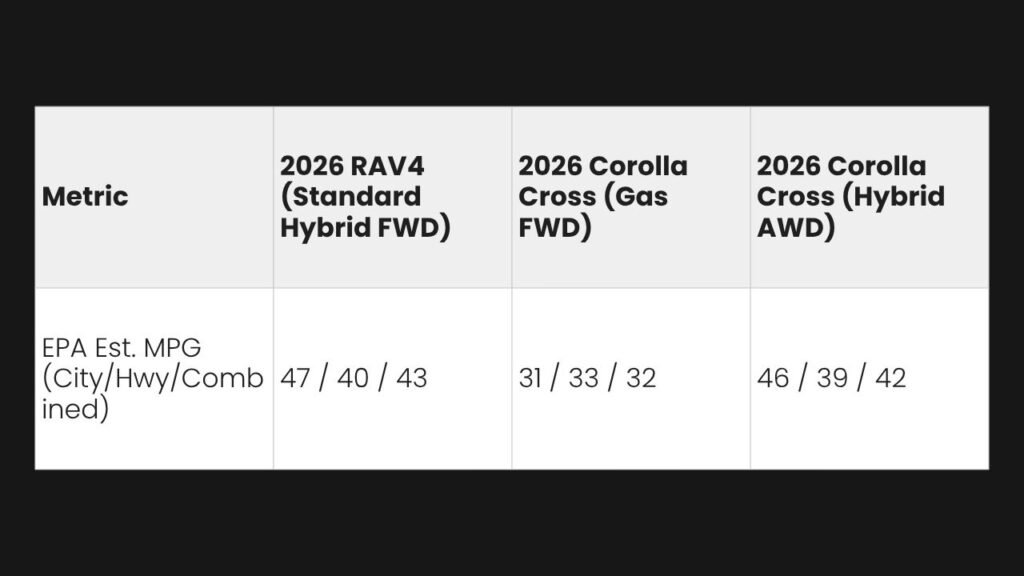
Both vehicles are incredibly efficient, but the redesigned RAV4 squeezes phenomenal numbers out of its larger body:
Rear Seat Dividing Line
Up front, the driver and passenger will find both cabins perfectly accommodating. In fact, the Corolla Cross actually edges out the RAV4 in front legroom (42.9 inches vs. 41.0 inches). However, the story shifts dramatically in the second row.
- The RAV4 offers 37.8 inches of rear legroom, allowing full-sized adults to sit comfortably on long road trips.
- The Corolla Cross drops to 32.0 inches of rear legroom. This 5.8-inch deficit means the rear seat is best suited for children, quick city trips, or keeping the seats folded down for cargo. Narrower rear door openings also make installing bulky, rear-facing child safety seats noticeably tighter in the Cross.
Cargo Capacity
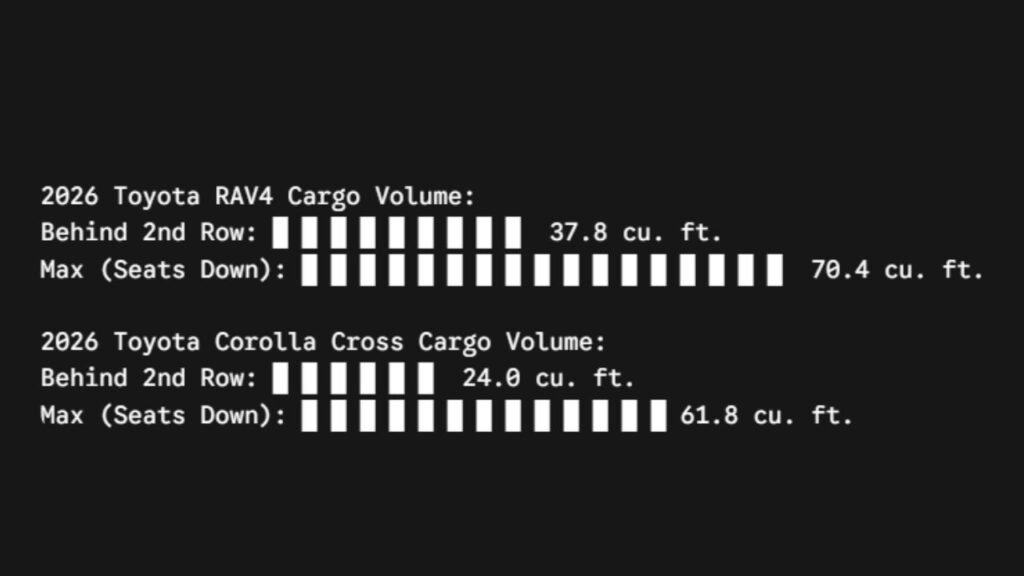
If you routinely haul gear, luggage, or large grocery runs, the RAV4 is difficult to outgrow:
Cabin Tech & Aesthetic Philosophies
Step inside either crossover, and you’ll notice two completely different design languages.
- RAV4: Rugged Ergonomics The sixth-generation RAV4 relies on a truck-like, expedition-ready aesthetic. The dash layout is functional and dominated by large, rubberized climate dials, extensive storage cubbies, and high-wear materials. Tech gets a massive upgrade here, featuring a standard 10.5-inch multimedia touchscreen and a 12.3-inch digital gauge cluster on higher trims, running on Toyota’s fast new software architecture.
- Corolla Cross: Minimalist Simplicity The Corolla Cross borrows its interior almost entirely from the Corolla sedan. It features a much lower, cleaner dashboard fascia, a floating screen (an 8-inch screen is standard, while a 10.5-inch screen is available on top trims), and a narrower center console. It relies on harder plastics to keep costs down, delivering an environment that feels like a safely elevated, high-riding passenger car rather than an off-road utility vehicle.
Both models come standard with Toyota Safety Sense 3.0, packing vital driver-assist tech like adaptive cruise control, lane-keeping assist, and pedestrian detection out of the box.
Pricing and Value Strategy
Because the RAV4 has shed its base gas engine, its starting price has naturally migrated upward, widening the financial gap between these two models.
- The Corolla Cross Strategy: Starts roughly around the mid-$24k mark for the base gas model, with the standard AWD Hybrid variant beginning near $29,000. A fully loaded Corolla Cross Hybrid XSE tops out around $35,000.
- The RAV4 Strategy: Starts higher, with base models beginning past the $33,000 mark. Upmarket trims like the Woodland, XSE, or Limited easily climb into the late $30k and $40k territory.
This creates an interesting crossover point: A fully loaded, top-tier Corolla Cross Hybrid costs roughly the same as a base-model RAV4 Hybrid.
Choose the 2026 Toyota Corolla Cross if:
- You want the absolute lowest entry price or prefer a traditional, non-hybrid powertrain.
- You live or commute in a dense urban environment where tight parking spaces and nimble city maneuverability are a daily priority.
- You primarily drive alone or with one passenger, rarely needing to host adults in the back seat.
Choose the 2026 Toyota RAV4 if:
- You are looking for a versatile, long-term family vehicle that you won’t outgrow as kids grow or hobbies expand.
- You require genuine utility—whether that means hauling bicycles, camping gear, packing out a massive trunk, or towing up to 3,500 pounds.
- You want the latest, most powerful hybrid technology Toyota offers and prefer a higher, more commanding seating posture on the highway.