When Ford pulled the plug on the original Ranchero in 1979, few expected the iconic “car-with-a-bed” badge to return nearly half a century later in a radically different form. Yet, with affordable compact trucks experiencing a massive resurgence and mainstream EV adoption stalling due to runaway prices, Ford is preparing to play its most ambitious card yet.
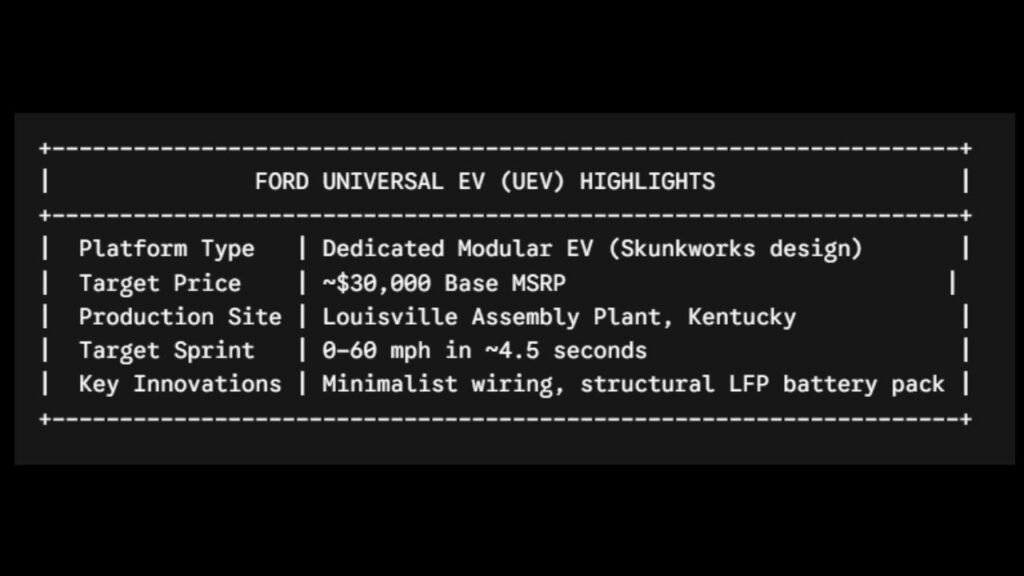
Built on Ford’s high-stakes Universal EV (UEV) platform, the expected 2028 Ford Ranchero is designed to be the “Model T moment” for the modern electric age—targeting a starting price right around $30,000.
The Backstory: Why Bring Back the Ranchero?
The original 1957–1979 Ranchero pioneered the idea of blending passenger-car comfort with light-duty utility. It was lower, smoother, and vastly easier to drive than the high-riding work trucks of its era.
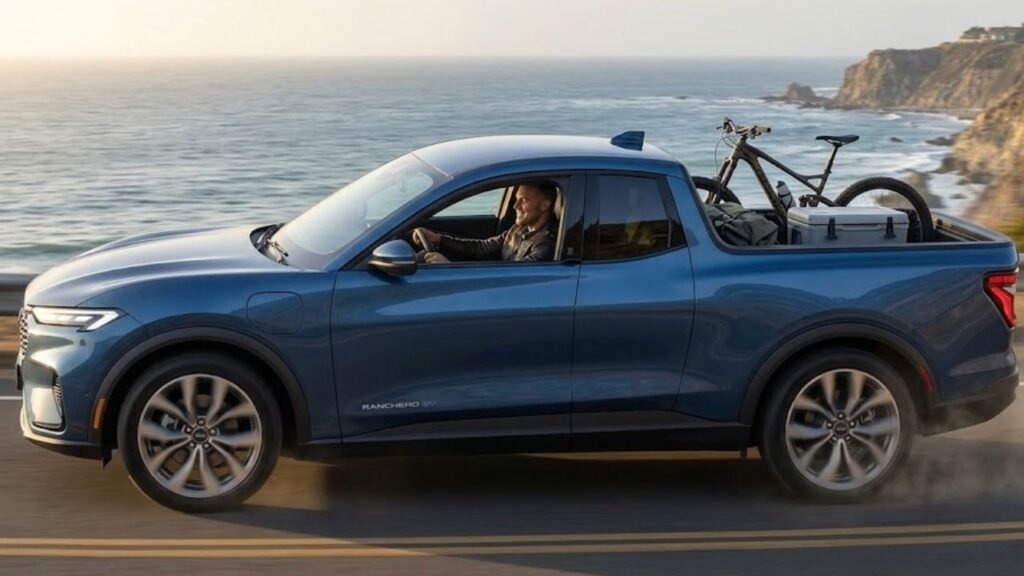
Fast forward to today: Ford’s wild success with the hybrid-first Maverick proved that drivers are starving for small, efficient, utility-focused vehicles. However, while the Maverick caters to hybrid and traditional gas buyers, Ford needed a dedicated, ground-up answer to lower-cost electric utility. Enter the Ranchero reboot—a low-slung, highly aerodynamic compact EV pickup slated to enter production at the Louisville Assembly Plant in Kentucky.
Platform & Engineering: The Universal EV (UEV) Architecture
At the heart of the 2028 Ranchero is Ford’s clean-sheet Universal EV platform. Developed by a specialized skunkworks team in California, this architecture is stripped of typical manufacturing bloat:
- Simplified Assembly: The UEV platform uses roughly 20% fewer parts and 20% fewer fasteners compared to Ford’s early EV efforts. Large front and rear mega-castings sandwich a structural battery pack that doubles as the cabin floor.
- Chemistry & Voltage: Rather than chasing expensive 800-volt charging setups, the Ranchero sticks to a cost-conscious 400-volt architecture paired with Lithium Iron Phosphate (LFP) battery chemistries. LFP cells are cheaper, highly durable, and allow for regular 100% charging without rapid degradation.
- Aerodynamic Focus: Unlike the brick-shaped F-150 Lightning, early spy photos and concept teasers reveal a lower, swooping front end designed to minimize highway drag by up to 30%, stretching every kWh as far as possible.
Interior & Packaging: Big Space, Small Footprint
Despite having an exterior length that is expected to be slightly shorter than the current Maverick, Ford’s EV packaging works wonders inside. Without a front combustion engine or transmission tunnel in the way, the Ranchero claims to deliver:
- More Rear-Seat Legroom Than a RAV4: By pushing the front wheels forward and opening up the dash, the cabin feels shockingly spacious for a compact vehicle.
- Dual Cargo Spaces: A functional rear pickup bed paired with a weather-sealed front trunk (frunk) gives owners flexible storage options for gear, groceries, or dirty equipment.
- Tech-Forward Cabin: Expect a streamlined dashboard centered around a single high-definition display, featuring full over-the-air update capabilities and integrated mobile power delivery.
Performance & Daily Driving Expectations
While exact range figures remain under wraps ahead of its full reveal, Ford is targeting a competitive 300-mile range threshold for its mid-tier battery packs.
- Target Acceleration: Ford claims the dual-motor variants will hit 0–60 mph in 4.5 seconds—putting it on par with an EcoBoost Mustang.
- Low Center of Gravity: True to its 1950s car-based roots, placing the heavy LFP battery low in the chassis gives the new Ranchero planted, car-like cornering dynamics that standard tall pickups can’t replicate.
Market Positioning: How It Stacks Up
The 2028 Ranchero won’t just compete against traditional compact utility vehicles; it will redefine what an entry-level EV looks like.
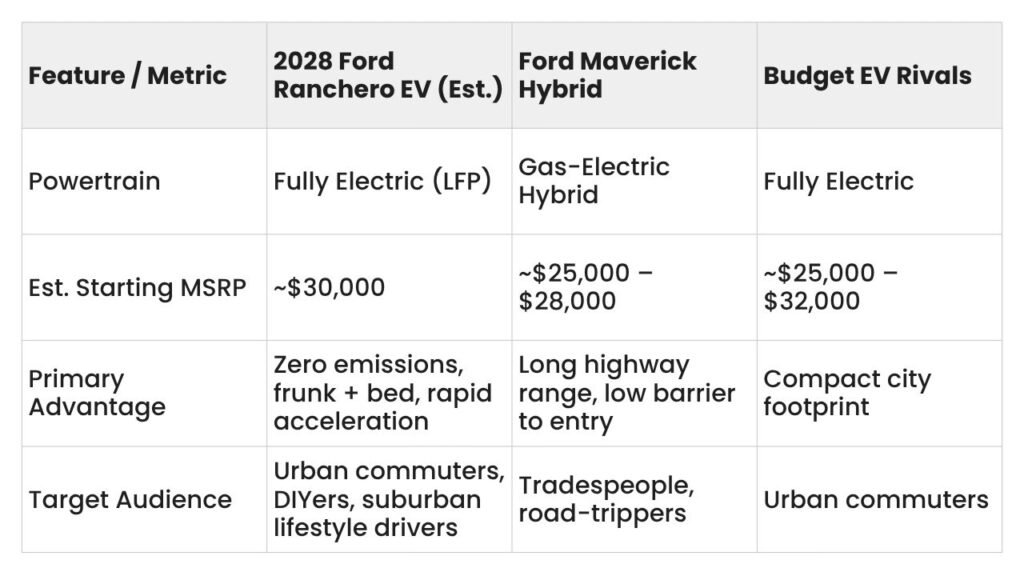
The 2028 Ford Ranchero represents a crucial pivot for the automaker. Instead of building $80,000 heavy-duty electric trucks that strain average household budgets, Ford is going back to its roots: simple, clever, and genuinely affordable utility. If Ford can hit its sub-$30k target while delivering on space and range, the Ranchero could easily become the defining vehicle of the budget EV era.