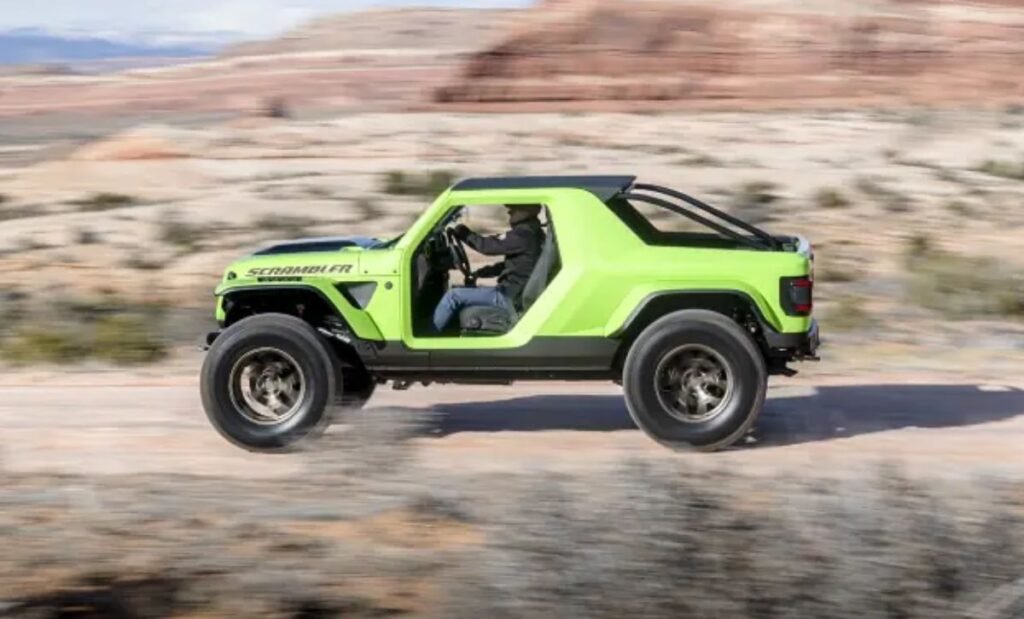
Jeep is reviving one of the most celebrated nameplates in its history with the confirmation of the 2028 Jeep Scrambler. Previewed during Stellantis investor presentations as a future halo vehicle, the new Scrambler directly addresses a long-standing enthusiast demand: a focused, two-door, open-air pickup built for high-speed desert running and serious off-road trail work.
CJ-8 Heritage
The original Jeep CJ-8 Scrambler (produced from 1981 to 1986) combined the open-top trail capability of the CJ-7 with a lengthened wheelbase and a usable rear pickup bed. While total production was under 30,000 units during its initial run, the CJ-8 evolved into a collector icon. When Jeep launched its mid-size truck in 2019, it opted for the four-door “Gladiator” moniker.
The 2028 Scrambler returns to the shorter, two-door footprint that made the original distinctive, positioning itself as a performance-oriented lifestyle truck rather than a conventional mid-size work vehicle.
| Feature | 2028 Jeep Scrambler (Expected / Confirmed Details) |
| Cab / Configuration | 2-Door Regular Cab with integrated cargo bed |
| Front Suspension | Independent Front Suspension (IFS) |
| Rear Suspension | Solid Axle or Multi-Link IRS (Under evaluation) |
| Halo Powertrain | 6.4L HEMI V8 (470 hp / 470 lb-ft) / SRT-tuned variant |
| Alternative Powertrains | 3.0L Twin-Turbo Hurricane I6 / 4xe Hybrid (Potential lower trims) |
| Transmission | 8-Speed Automatic with 4WD low-range transfer case |
| Estimated Base Price | ~$75,000 – $90,000 (SRT Halo spec) |
Mechanical Shift: Moving to Independent Front Suspension
The most significant engineering departure for the 2028 Scrambler is Jeep’s decision to move away from a traditional solid front axle in favor of an Independent Front Suspension (IFS) setup.
- High-Speed Stability: Solid front axles excel at extreme low-speed rock crawling articulation, but IFS provides superior damping control, wheel tracking, and chassis stability when driving over washboard terrain, dunes, and open desert trails at speed.
- Market Targeting: This chassis direction allows Jeep to compete directly against high-speed factory off-roaders like the Ford Bronco Raptor and F-150 Raptor without compromising daily on-road driving dynamics.
- Platform Sharing: Structural elements of this performance IFS setup are expected to inform other rugged high-performance off-road projects across Stellantis platforms.
Powertrain Guide
Previews of the vehicle showed prominent SRT badging, signaling that the Scrambler will debut near the top of Jeep’s performance lineup.
- HEMI V8 Option: The primary performance candidate is the naturally aspirated 6.4L HEMI 392 V8, delivering 470 horsepower and 470 lb-ft of torque paired with an 8-speed automatic transmission.
- Hurricane Twin-Turbo I6: Stellantis’ 3.0-liter twin-turbocharged inline-six serves as a logical secondary or standard powertrain option, delivering broad low-end torque while satisfying modern efficiency requirements.
Design and Body Configuration
The 2028 Scrambler balances modern Wrangler ergonomics with retro design cues:
- Open-Air Modular Body: Removable roof panels and removable doors remain standard, preserving Jeep’s signature open-air cabin format.
- Proportions: A squared-off front fascia paired with a compact 2-door cab creates a short, aggressive wheelbase with high approach and departure angles.
- Bed Utility: The compact cargo bed is sized for carrying spare tires, recovery tracks, camping gear, and recreational equipment without the excessive rear overhang seen on conventional crew-cab pickups.
Market Outlook
The 2028 Jeep Scrambler occupies a distinct niche in the off-road landscape. Rather than competing directly on commercial payload or towing volume with mainstream trucks, it is engineered as an enthusiast-focused, high-performance desert runner designed to combine open-top retro character with high-output factory tuning.