When automakers redesign budget city cars, the formula is usually predictable: tweak the front fascia, install a slightly larger touchscreen, and roll out a couple of fresh paint colors. BYD is tearing up that playbook. Regulatory filings from China’s Ministry of Industry and Information Technology (MIIT) and early reports from Autohome reveal that the second-generation BYD Seagull is receiving a comprehensive mechanical re-engineering.
From a brand-new rear-wheel-drive architecture to unexpected tech upgrades, the automaker’s entry-level EV is making a surprisingly aggressive move upmarket. Here is a breakdown of everything changing on BYD’s smallest electric hatchback.
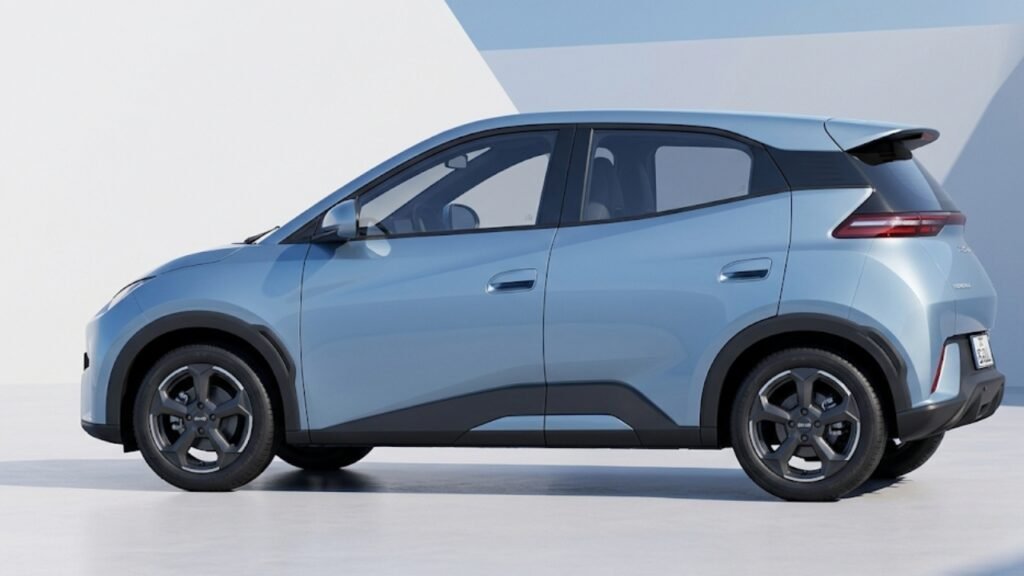
1. Drivetrain Shift: Hello, Rear-Wheel Drive
The headline change is underneath the floorboards: the Seagull is switching from front-wheel drive (FWD) to rear-wheel drive (RWD).
The original Seagull relied on a modest, front-mounted 55 kW motor. The second-gen model moves the electric drive unit directly to the rear axle with a new motor designated TZ164XYB (produced by Jiangxi BYD Auto Co., Ltd.). Moving an entry-level vehicle from FWD to RWD is a bold engineering maneuver in a segment defined by razor-thin margins and cost containment, but it promises superior weight distribution, sharper turn-in, and zero torque steer.
2. A Massive Leap in Horsepower
Alongside the layout swap comes a serious bump in output:
- Old Output: 55 kW (~74 hp)
- New Output: 95 kW (~127 hp)
- Top Speed: 150 km/h (93 mph)
A jump of over 70% in horsepower transforms the Seagull from a strictly around-town runabout into an EV that can comfortably handle highway merging and overtaking without running out of breath.
3. Smarter Packaging Brings a Frunk
Moving the powertrain hardware to the rear axle freed up valuable real estate under the hood. BYD capitalized on the empty space by adding a front trunk (frunk).
In China’s sub-100,000 RMB (under ~$14,000 USD) segment, dedicated front storage is virtually unheard of. While BYD has not released official volume metrics yet, having a separate compartment to stow charging cables, dirty gear, or grocery bags is a massive everyday win for a car of this footprint.
4. Multi-Link Rear Suspension and Wider Rubber
The chassis upgrades go far beyond the motor mount:
- Suspension: The previous model’s budget-friendly torsion beam rear axle has been replaced with an independent multi-link rear suspension. This should significantly improve wheel articulation, bump absorption, and mid-corner stability on uneven pavement.
- Tire Contact Patch: The outgoing car rode on skinny 165 mm or 175 mm rubber. The new car steps up to 205/60 R16 tires wrapped around 16-inch dual four-spoke alloy wheels, giving it a much wider footprint, better grip, and a planted stance.
5. Matured Exterior Styling
Visually, the new Seagull has grown up. Key exterior updates include:
- Handles: Practical semi-hidden mechanical door handles replace the fussy pop-out flush units.
- Rear Profile: A more athletic rear end sporting split taillights, a prominent roof-mounted spoiler, and an integrated lower diffuser.
- Proportions: Measuring 4,025 mm long on a 2,650 mm wheelbase, the new model is noticeably longer and wider, ditching the slightly toy-like proportions of its predecessor.
6. Cabin Modernization: Clean Minimalist Layout
Inside, earlier leaks reveal a streamlined, decluttered cabin:
- Elimination of the traditional gauge cluster in favor of an expansive central floating touchscreen.
- A redesigned, flat-bottom two-spoke multifunction steering wheel.
- Physical tactile controls have not been abandoned: satisfying toggle-style rocker switches sit neatly beneath the air vents.
- A redesigned center console with a dedicated wireless phone charging pad and tandem cupholders.
7. Advanced Driver Assistance: LiDAR on a Budget EV?
Engineering test vehicles have been spotted carrying a roof-mounted LiDAR pod. This sensor suite is expected to feed into BYD’s DiPilot 300 (branded as “God’s Eye” Level 2 driver assistance). While likely reserved for higher trim levels, offering advanced semi-autonomous highway and urban navigation hardware in this price bracket would set a major benchmark for the segment.
BYD Seagull Gen 1 vs. Gen 2 (At a Glance)
| Spec / Feature | First-Generation Seagull | Second-Generation Seagull |
| Drivetrain | Front-Wheel Drive (FWD) | Rear-Wheel Drive (RWD) |
| Motor Output | 55 kW (~74 hp) | 95 kW (~127 hp) |
| Top Speed | 130 km/h | 150 km/h |
| Rear Suspension | Torsion Beam | Independent Multi-Link |
| Front Trunk (Frunk) | No | Yes |
| Tire Dimensions | 165 mm / 175 mm | 205/60 R16 |
| Sensors / ADAS | Basic Radar / Cameras | Optional Roof-Mounted LiDAR (DiPilot 300) |
Why the Drastic Redesign? The Geely Rivalry
BYD isn’t overhauling the Seagull just for fun—it is responding directly to fierce domestic pressure, most notably from the Geely Geome Xingyuan (sold internationally as the EX2).
The Geely Xingyuan landed right in the Seagull’s crosshairs with a nearly identical formula: rear-wheel drive, independent rear suspension, a frunk, and a matching 2,650 mm wheelbase. The sales impact was immediate: recent Chinese market registration figures showed the Xingyuan rapidly outpacing the first-gen Seagull, booking nearly 40,000 retail registrations in a single month compared to the older Seagull’s ~10,000.
By stretching the car to 4,025 mm (roughly 70 mm longer than Geely’s contender) and introducing a punchy 127 hp motor with optional LiDAR, BYD is mounting a direct counterattack. Rumors also suggest upper trims could adopt BYD’s second-generation Blade Battery with ultra-fast “flash charging,” though official specs remain under wraps.