Chassis and Suspension
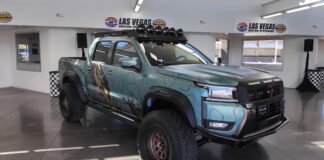
Standard mid-size suspension isn’t enough to deal with catching air and taking significant knocks out in the desert. So Nissan used the beefier rear axle and suspension from the full-size Titan.
They installed a Bilstein Black Hawk suspension system with four-way adjustable coil-overs, internal hydraulic bump stops and substantial bypass damping. The Ronin is 4 inches taller and a full 12 inches wider than a stock Frontier, and with special CJD Racing long-travel parts adds 14 inches of suspension travel. It sits on enormous 35-inch Yokohama Geolandar tyres and prototype NISMO beadlock wheels.
The Capability Benchmark
As it stands, the Ranger Raptor and Tacoma TRD Pro have around 11 inches of ground clearance. The Ford even features a special ‘Baja mode’ that tunes the suspension, four-wheel drive and turbo anti-lag for flat-out desert driving.
But the long-travel suspension, ultra-wide stance and 35-inch tires inherited from the Titan indicate just how the Ronin concept intends to match and perhaps even exceed – that kind of high-speed Baja prowess.
Wheels, Tires, and Braking
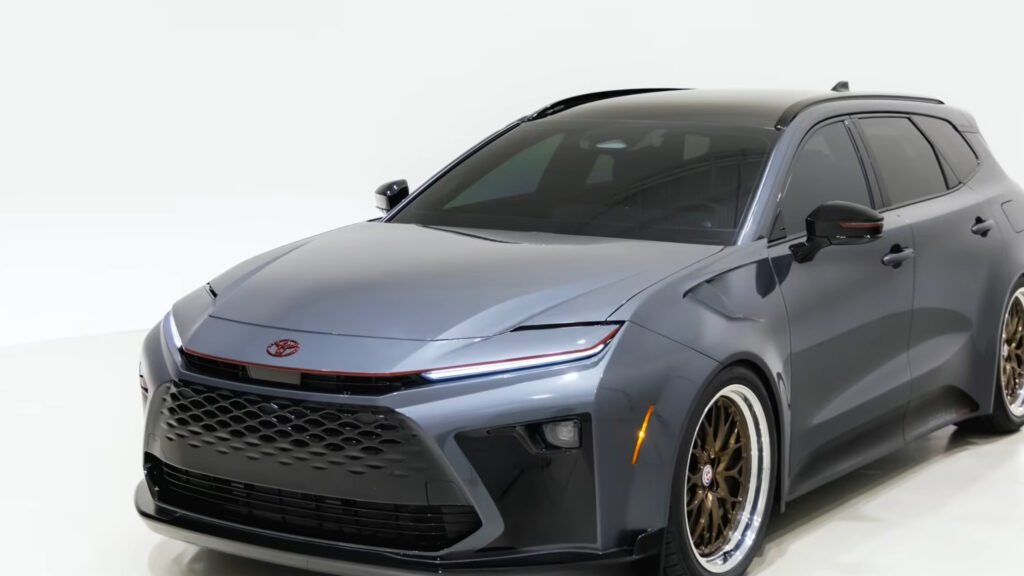
Power The enlarged wheel wells are stuffed with custom forged 21-inch HRE alloy wheels. They roll on gigantic 295-mm wide Toyo Proxes ST III performance tyres at all four corners.
This wheel and tire set increases the rubber contact patch by 20% above the standard manufacturing model, dramatically increasing mechanical grip.
To keep this aggressive setup in check the braking system was completely refurbished with OEM-plus parts. To match the enhanced grip of the chassis, the bigger, heavy-duty front and rear brake callipers are adapted from the high-performance Lexus RX 500h F SPORT.
Wide-body exterior and aerodynamic
The widebody fenders, which elegantly contain the increased track without seeming bolted on, are totally integrated into the exterior shell. In order to lessen front-end lift at speed, functional front fender vents remove high-pressure air from the wheel wells.
In order to achieve a deep glass-like gloss under car show illumination, the paint is a custom-made dark grey metallic with heavy metal flake and numerous clear coatings.
In contrast to the darker colour, Toyota’s unique hammerhead front fascia and external badging include vivid red highlights, a clear nod to the company’s past TRD (Toyota Racing Development) colour schemes. In order to give the rear end a strong, grounded stance, the standard bumper trim is swapped out for a special aero diffuser that gracefully frames twin trapezoidal exhaust points.
Upgrades to the Cabin and Historical Details
Inside, the emphasis switches from luxury to the needs of the driver. Heavily bolstered sports bucket seats, intended to keep passengers secure during high-G cornering, have replaced the conventional front seating.
In addition to “GT-S” writing sewn directly into the headrests, these seats have deep crimson inlays that match the exterior elements, a subdued homage to the legendary Celica GT-S of the past. To keep the driver’s attention solely on the road, the remainder of the cabin is completed with dark, low-reflection materials.
Production Reality and Powertrain
The Toyota Motorsports Garage did not alter the OEM powertrain in any way, despite the motorsport appearance. The conventional 2.5-liter four-cylinder hybrid engine, which produces 243 horsepower, powers the idea. This unit is combined with Toyota’s on-demand all-wheel drive technology and an electronic continuously variable gearbox (eCVT).
The Crown Signia GT-S is still a pure design study made entirely of bespoke fabrication and aftermarket parts. Although it is not intended for factory production and is not street legal, it effectively illustrates the Crown Signia platform’s underlying tweaking capabilities.