For nearly two decades, the Ford Edge occupied one of the most practical sweet spots in the American crossover market. Positioned neatly between the compact Escape and the three-row Explorer, the Edge earned a loyal following by delivering a simple, highly appealing formula: generous two-row passenger volume, standard all-weather capability, a commanding ride height, and road-trip-ready cargo capacity.
However, entering the 2025 automotive landscape, the Ford Edge finds itself in a fascinating and pivotal position. Between platform retirements in North America, ongoing fleet transitions toward electrification, and the divergence of international models, potential buyers have questions about where the vehicle stands, what features it delivers, and whether it still makes sense to put one in your driveway.
Below is an exhaustive, deep-dive evaluation of the 2025 Ford Edge—examining mechanical configurations, daily road performance, interior ergonomics, trim structures, competitive alternatives, and ownership realities.
1. The Market Reality: Production Status and Global Divergence
Before digging into horsepower numbers and cargo specs, it is crucial to address the structural status of the Ford Edge.
The North American Context
For the North American market, the long-running second-generation Ford Edge reached the conclusion of its assembly run at Ford’s Oakville Assembly Complex in Ontario, Canada, as the plant retools for next-generation vehicle manufacturing. As a result, 2025 model-year units and carryover inventory sitting on dealer lots represent the culmination of this proven generation.
For prospective buyers, this dynamic creates a distinct advantage: maturity and leverage. Unlike brand-new generation vehicles that often suffer from early software bugs or assembly teething issues, the final run of the Edge utilizes mechanical platforms and electronics that have been thoroughly refined over years of production.
Furthermore, dealerships looking to clear remaining two-row SUV inventory frequently offer attractive financing programs, lease incentives, and price flexibility.
The Global Divergence: The Edge L
In select global markets—most prominently China via the Changan-Ford joint venture—the nameplate lives on in the form of the Ford Edge L. This is a radically different vehicle: a longer, three-row crossover built on an updated architecture featuring hybrid powertrains, a monolithic coast-to-coast dashboard display, and distinct styling cues shared with the modern Mondeo and Evos.
For the purposes of this guide, our primary focus is on the proven two-row midsize platform that defined the vehicle’s identity across western dealerships, alongside comparisons to modern rivals.
2. Exterior Design and Platform Architecture
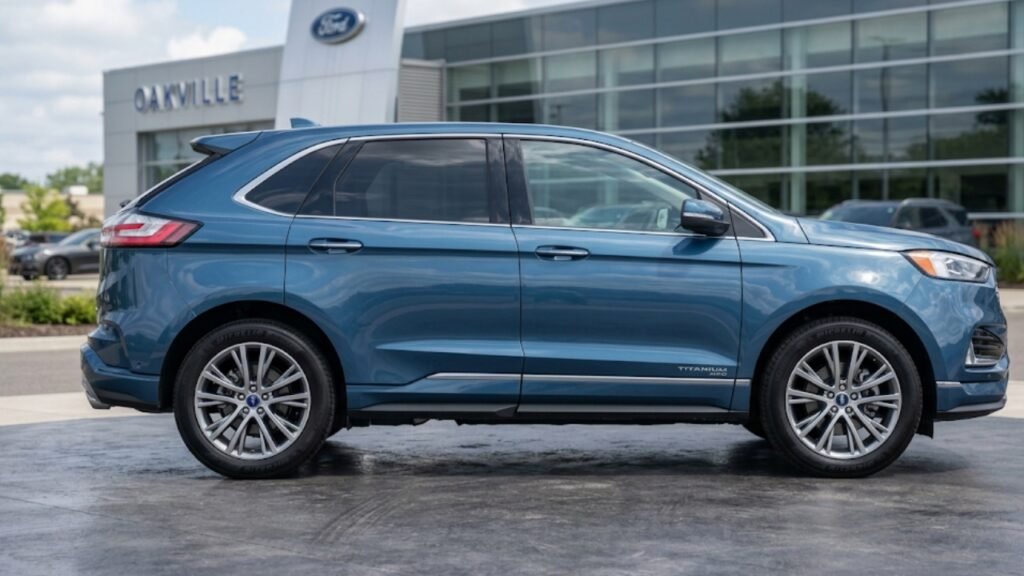
The Ford Edge has maintained a confident, athletic visual presence that avoids the overly boxy profile of rugged off-roaders while steering clear of fragile station-wagon proportions.
Proportions and Stance
The Edge rides on a 112.2-inch wheelbase with an overall vehicle length of 188.8 inches. At 75.9 inches wide (excluding mirrors) and roughly 68.3 inches tall, it provides a notably wider track than compact crossovers like the Honda CR-V or Toyota RAV4. This width gives the Edge genuine highway stability and an imposing presence from the front three-quarter view.
Lighting and Aerodynamics
Every model comes standard with bi-LED headlamps featuring integrated LED signature daytime running lights (DRLs). Ford’s signature hexagonal grille is flanked by functional aerodynamic side curtains in the front bumper that channel airflow smoothly around the spinning front wheels, reducing drag at cruising speeds. Active grille shutters open and close automatically to balance engine cooling demands with highway aerodynamic efficiency.
Visual Trim Differentiation
The exterior personality changes significantly depending on the trim package:
- SE & SEL: Understated, clean daily drivers with subtle body cladding, body-color door handles, and bright silver alloy wheels ranging from 18 to 19 inches.
- ST-Line: Tailored for drivers who want the aggressive, track-inspired aesthetic of the full-fledged ST without the premium fuel bill. It features blacked-out grille mesh, black mirror caps, dark headlamp bezels, aggressive front chin spoilers, body-color lower cladding, and bold 20-inch gloss-black aluminum wheels.
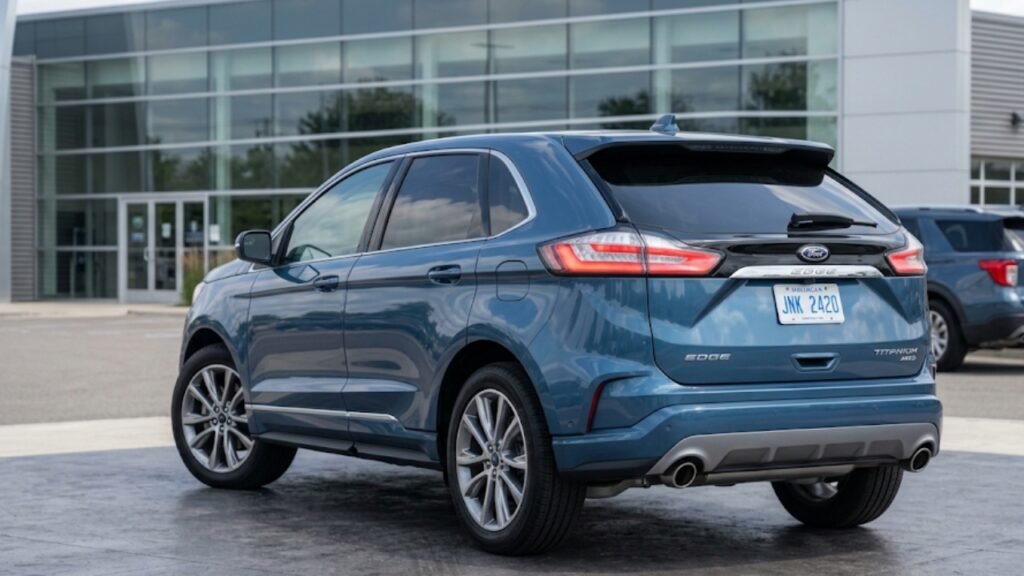
- Titanium: Emphasizes upscale refinement, swapping blacked-out panels for bright chrome accents along the window belts, satin metal grille surrounds, functional LED fog lamps with bright bezels, and optional 20-inch polished or bright-machined aluminum wheels.
- ST: The genuine performance model, identifiable by its massive dual trapezoidal exhaust tips integrated into a sculpted rear diffuser, dedicated Ford Performance badging, functional red brake calipers (when optioned with the ST Performance Brake Package), and available 21-inch gloss-black wheels wrapped in wide performance rubber.
3. Powertrains, Transmission, and Driving Dynamics
Under the hood, the Edge avoids the sluggish naturally aspirated engines found in entry-level crossovers, opting instead for two distinct turbocharged EcoBoost powertrains.
| Specification | 2.0L EcoBoost Inline-4 (Standard) | 2.7L EcoBoost Twin-Turbo V6 (Edge ST) |
| Aspiration | Twin-scroll Turbocharger | Twin Turbochargers |
| Displacement | 1,999 cc (2.0 Liters) | 2,694 cc (2.7 Liters) |
| Engine Block | High-pressure die-cast aluminum | Compacted Graphite Iron (CGI) |
| Horsepower | 250 hp @ 5,500 rpm | 335 hp @ 4,750 rpm (on 93 octane) |
| Torque | 280 lb-ft @ 3,000 rpm | 380 lb-ft @ 3,250 rpm (on 93 octane) |
| Transmission | 8-speed SelectShift Automatic | 7-speed Quick-Shift Automatic |
| Drivetrain | Standard Intelligent AWD | Standard Intelligent AWD |
| Fuel Delivery | Direct Fuel Injection | Direct + Port Fuel Injection |
| 0–60 mph Time | ~7.2 seconds | ~5.7 seconds |
| Max Towing | Up to 3,500 lbs (with Class II tow pack) | Up to 3,500 lbs (with Class II tow pack) |
| Fuel Economy (EPA) | 21 City / 28 Hwy / 23 Combined mpg | 19 City / 25 Hwy / 21 Combined mpg |
The Everyday Workhorse: 2.0L Twin-Scroll EcoBoost
The standard engine across SE, SEL, ST-Line, and Titanium trims is a 2.0-liter turbocharged four-cylinder. The twin-scroll turbocharger design channels exhaust pulses from alternating cylinders into separate chambers inside the turbo housing. This drastically mitigates turbo lag, producing a flat, immediate torque curve that reaches its 280 lb-ft peak at 3,000 rpm.
In city driving, power delivery feels immediate and confident. Passing power on single-lane county highways requires minimal planning, as the engine delivers ample midrange punch without having to rev frantically toward redline.
Paired with this engine is an 8-speed automatic transmission operated via a space-saving rotary gear shift dial on the center console. The transmission mapping prioritizes smooth, imperceptible upshifts in everyday driving, quickly reaching tall overdrive gear ratios on highway stretches to maximize fuel efficiency.
Standard Intelligent All-Wheel Drive (AWD)
Unlike many competitors that charge a $1,500 to $2,000 premium for all-wheel drive, AWD comes standard on every trim. The system uses a continuous array of vehicle sensors—monitoring wheel spin, throttle input, steering angle, and ambient temperature—to proactively distribute torque between the front and rear axles.
- Under cruising conditions on dry asphalt: The system seamlessly disconnects the rear driveline components to minimize parasitic drag, sending near 100% of torque to the front wheels to conserve fuel.
- Under hard acceleration or slip conditions: The system engages the rear differential clutch pack in milliseconds, redirecting up to 50% of available torque rearward before front-wheel slip can destabilize the vehicle.
The Sleeper Muscle: 2.7L Twin-Turbo EcoBoost V6 (ST)
For enthusiasts who need family utility but refuse to drive an uninspired commuter, the Edge ST remains an anomaly in this segment. Engineered directly by the Ford Performance division, the 2.7-liter twin-turbo V6 utilizes a compacted graphite iron (CGI) engine block—the same high-strength material Ford uses in its heavy-duty Power Stroke diesel engines.
Delivering 335 horsepower and 380 lb-ft of torque, the ST rockets from zero to 60 mph in roughly 5.7 seconds. When toggled into Sport Mode, the character of the vehicle transforms:
- Throttle mapping sharpens significantly.
- The steering rack increases in weighting, providing tangible feedback through the leather-wrapped wheel.
- The 7-speed automatic holds lower gears deeper into the rev band and executes rev-matched downshifts under braking.
- The cabin is treated to an authentic, throaty exhaust note routed via the tuned exhaust plumbing.
Ride Quality, Suspension, and Noise Isolation
Every Edge rides on a fully independent suspension architecture—MacPherson struts up front with an isolated subframe and an integral-link independent rear suspension with coil springs and anti-roll bars.
The standard suspension is tuned primarily for compliance. It glides over potholes, frost heaves, and expansion joints with minimal shudder transmitting into the passenger cabin. Acoustic laminated front side glass (standard on Titanium and optional on other trims) pairs with active noise cancellation hardware to keep tire hum and wind whistle remarkably muted at 75 mph highway speeds.
The ST model replaces the base dampers with stiffer, monotube units and thicker anti-roll bars. While the ride over broken urban asphalt is noticeably firmer, body roll in tight sweepers is remarkably controlled for a two-row SUV tipping the scales at nearly 4,500 pounds.
4. Interior Comfort, Ergonomics, and Technology
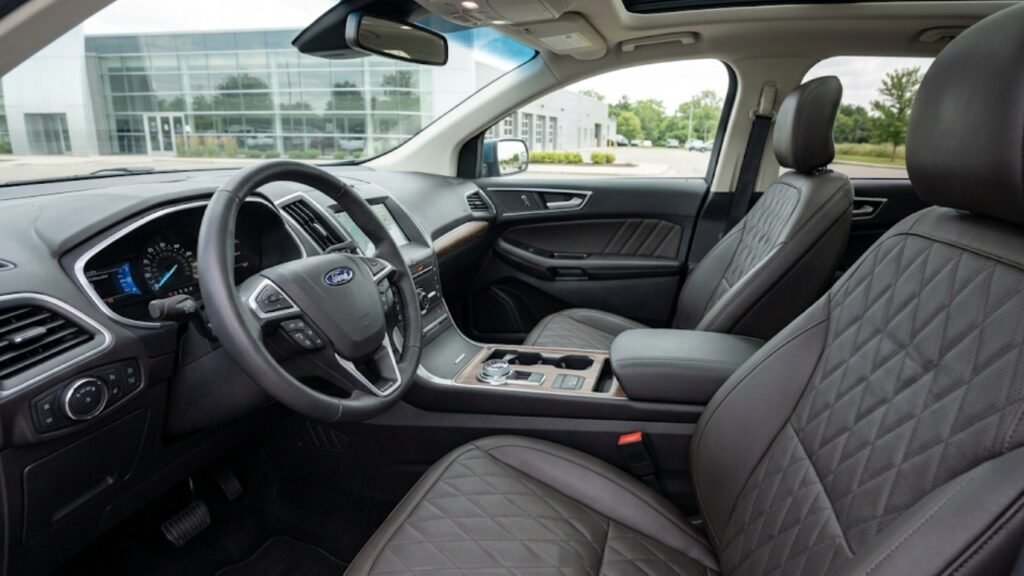
While subcompact and compact crossovers often crowd adult passengers in the rear seats, the midsize two-row footprint of the Edge yields an exceptionally accommodating cabin environment.
Seating Architecture and Space
The front bucket seats provide long-distance orthopedic support with thick foam padding, generous seat-bottom width, and wide bolster spacing. On SEL trims and higher, front passengers receive multi-stage heating, while the range-topping Titanium adds optional multi-stage seat ventilation.
The second row is where the Edge outshines smaller rivals:
- Legroom: A massive 40.6 inches of rear legroom means six-foot-tall adults can comfortably sit behind six-foot-tall front occupants with room to spare.
- Shoulder & Hip Room: The expansive cabin width allows three adults to sit across the rear bench on medium-length trips without severe shoulder crowding.
- Seat Adjustability: The rear 60/40 split seatbacks feature standard manual recline levers, allowing rear passengers to lean back during long road trips.
The Central Tech Hub: SYNC 4A on a 12-Inch Display
The centerpiece of every modern Ford Edge cabin is the standard portrait-oriented 12.0-inch touchscreen powered by Ford’s proprietary SYNC 4A software platform. Key highlights of this infotainment interface include:
- Wireless Smartphone Mirroring: Wireless Apple CarPlay and Android Auto connect automatically when you enter the vehicle, freeing the center console from tangled charging cables.
- Adaptive Dash Cards: The user interface features interactive, customizable cards at the bottom of the display that show recently used functions (e.g., audio, tire pressure, navigation directions), allowing you to multitask without losing sight of your primary mapping display.
- Connected Navigation and OTA Updates: Built-in cloud-connected navigation provides real-time traffic and weather routing, while Ford Power-Up over-the-air software updates can continuously upgrade onboard control modules without requiring a dealership visit.
- Physical Controls Preserved: Unlike systems that force drivers to adjust basic climate settings purely through complex sub-menus, the Edge preserves convenient, dedicated climate widgets anchored permanently at the base of the screen alongside a physical central volume knob.
Cargo Functionality and Utility
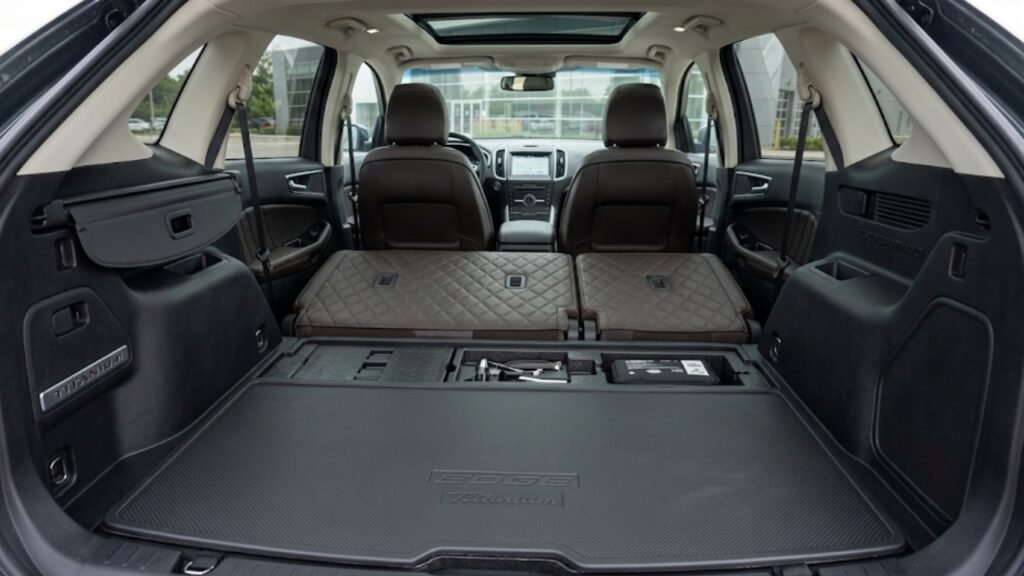
Behind the second-row seating, the Edge supplies a cavernous 39.2 cubic feet of flat cargo capacity. When moving large cargo, lowering the second row expands storage to a generous 73.4 cubic feet.
To make cargo loading effortless, several thoughtful features are integrated:
- EasyFold Electronic Seat Release: Pushbuttons located on the left wall of the rear cargo bay electronically drop the spring-loaded second-row seatbacks flat, eliminating the need to walk around to both side doors.
- Hands-Free Foot-Activated Liftgate: On Titanium and ST models (optional on SEL/ST-Line), kicking your foot beneath the center of the rear bumper opens or closes the motorized liftgate when your key fob is in your pocket.
- Underfloor Sub-Compartments: Surrounding the spare tire well are molded foam organizer trays, perfect for stowing emergency road kits, charging cords, trailer hitch balls, or damp muddy shoes out of sight.
5. Active Safety and Ford Co-Pilot360 Technology
Safety remains a top priority for midsize family vehicles. Every Ford Edge comes factory-equipped with the Ford Co-Pilot360 safety suite, utilizing forward-facing radar, windshield-mounted cameras, and ultrasonic perimeter sensors.
- Standard Active Safety Features: Pre-Collision Assist with Automatic Emergency Braking (AEB): Constantly monitors the road ahead for stopped vehicles or pedestrians. If a potential collision is detected, it alerts the driver visually and audibly; if the driver fails to respond, it automatically applies maximum braking force to mitigate or prevent impact.
- BLIS (Blind Spot Information System) with Cross-Traffic Alert: Yellow radar indicators illuminate inside the side mirrors when vehicles enter adjacent blind spots. When backing out of parking spaces, Cross-Traffic Alert scans up to 65 feet laterally, sounding an alert if cross-traffic approaches.
- Lane-Keeping System: Includes Lane-Keeping Alert (haptic steering wheel vibration) and Lane-Keeping Assist (subtle steering torque inputs to gently nudge the crossover back toward the center of the lane if drift occurs without signaling).
- Auto High-Beam Headlamps: Automatically activates high beams on pitch-black rural roads and dips them down to low beams the instant oncoming headlamps or preceding taillamps are detected.
- Rear View Camera with Built-In Lens Washer: A dedicated high-pressure fluid jet cleans road grime, dust, and winter salt off the reverse camera lens whenever the rear windshield washer is operated.
Available Advanced Safety Upgrades (Co-Pilot360 Assist+):
For higher trim levels, the optional Assist+ package adds:
- Adaptive Cruise Control with Stop-and-Go: Maintains a set following distance from highway speeds down to a complete standstill in rush-hour traffic, resuming acceleration once traffic moves.
- Lane Centering Assist: Uses continuous micro-steering adjustments to keep the vehicle centered between visible highway lane lines on long journeys.
- Evasive Steering Assist: Provides supportive steering torque boost if the driver abruptly steers to avoid a stopped vehicle detected by the forward radar.
6. Comprehensive Trim Level Breakdown
Choosing the right configuration depends entirely on your specific priorities regarding price, visual styling, interior luxury, or outright engine power.
1. Edge SE: The Value-Focused Commuter
The entry SE trim provides a clean, well-equipped package without high-cost fluff.
- Key Features: Standard Intelligent AWD, 2.0L EcoBoost engine, 12-inch SYNC 4A screen, dual-zone automatic climate control, 18-inch sparkle silver alloy wheels, bi-LED lighting, push-button start.
- Best For: Fleet buyers, budget-focused families, and commuters who prioritize AWD capability and cabin room over luxury appointments.
2. Edge SEL: The True Sweet Spot
The SEL represents the most popular trim in the portfolio, upgrading comfort surfaces and opening up optional packages.
- Key Features: Durable, easy-to-clean ActiveX synthetic leather upholstery, 10-way power driver’s seat, 4-way power passenger seat, heated front seats, LED signature accent lighting, rear parking sensors, auto-dimming rearview mirror.
- Best For: The typical consumer looking for optimal dollar-for-dollar value, cold-weather comfort, and low-maintenance upholstery.
3. Edge ST-Line: Aggressive Looks Without the V6 Premium
For drivers who love the bold visual presence of high-performance SUVs but prefer the fuel economy and lower purchase price of the four-cylinder powertrain.
- Key Features: 20-inch gloss-black aluminum wheels, blacked-out honeycomb grille, body-color lower side mouldings, red accent contrast stitching throughout the cabin, metallic sport pedals, ST-Line badging, power liftgate.
- Best For: Style-conscious buyers who want curb appeal and sporty design without incurring the added purchase price and higher fuel consumption of the twin-turbo V6.
4. Edge Titanium: First-Class Touring Comfort
The Titanium focuses on executive-level acoustic comfort, refined aesthetics, and audio excellence.
- Key Features: 12-speaker Bang & Olufsen premium audio system with subwoofer, heated steering wheel, hands-free foot-activated power liftgate, acoustic laminated front glass, ambient interior lighting, memory settings for driver’s seat and exterior mirrors.
- Best For: Commuters who spend hours on the interstate every week and want an upscale, exceptionally quiet cabin environment.
5. Edge ST: The High-Octane Sleeper
The range-topper engineered by Ford Performance brings true sports-car acceleration and cornering dynamics to the midsize utility category.
- Key Features: 2.7-liter twin-turbo EcoBoost V6 (335 hp / 380 lb-ft), sport-tuned suspension, 7-speed quick-shifting transmission with steering paddle shifters, sport bolstered leather/suede seating, dual polished exhaust tips.
- Available Options: ST Performance Brake Package (21-inch gloss black wheels, summer-only performance tires, vented 13.6-inch front brake rotors, red-painted calipers, performance brake pads).
- Best For: Enthusiast parents and drivers who need practical cargo room and all-weather traction but crave genuine sports car thrust.