The premium midsize luxury SUV segment has just entered a state of absolute war. Within weeks of each other, Germany’s fiercest rivals pulled back the curtains on their heavy hitters for the 2027 model year.While both vehicles target the exact same tax bracket, their philosophies have radically diverged.
BMW has broken the evolutionary chain entirely, launching a completely redesigned, fifth-generation X5 (G65) that acts as a bridge to its futuristic “Neue Klasse” era. Mercedes-Benz, on the other hand, has given its fourth-generation GLE an extensive, high-tech second facelift, leaning heavily into lavish cabin opulence, massive screens, and undeniable brand branding.
Here is how these two luxury benchmarks stack up across design, tech, and performance.
Exterior Design
The visual distinction between these two could not be starker. BMW has gone monolithic and minimalist; Mercedes has gone maximalist and ultra-branded.
2027 BMW X5
BMW has discarded the complex creases of the outgoing model for clean, slab-sided surfaces and an upright, commanding nose.
- The Face: The controversial, oversized kidney grilles are gone. In their place sit taller, thinner vertical grilles accented by a glowing LED outline. The headlamps debut the “Double-X” lighting signature, placing daytime running lights, low beams, and turn signals into single, sharp housings that flash a distinct X pattern.
- The Profile: To maintain a completely uninterrupted, aerodynamic side profile, BMW deleted traditional door handles entirely. High-gloss black winglet latches are now integrated flush into the B- and C-pillars, activating fully automated, brake-pedal-assisted closing doors when you step inside.
2027 Mercedes-Benz GLE
Mercedes has taken the existing GLE silhouette and given it a heavy dose of visual drama, leaning hard into its iconic iconography.
- The Details: Mercedes has gone “full luxury logo print” with the three-pointed star. The headlight DRLs, the inner taillight elements, and the massive front grille detailing are all constructed from hundreds of tiny three-pointed stars.
- The Stance: A new, glossy black plastic surround ties the headlights and the illuminated front grille together for a wider, unified look. At the rear, a dark horizontal bar now visually connects the taillights across the tailgate. It remains an elegant, familiar SUV shape, but it leaves zero doubt about who built it.
Interior Architecture
BMW X5
If you are a fan of physical switchgear or BMW’s iconic iDrive rotary controller, prepare for a shock: the rotary dial is officially dead.
- Panoramic Vision: BMW has eliminated the traditional instrument cluster in front of the driver. Instead, “Panoramic Vision” projects configurable data tiles across the entire lower width of the windshield base. Core data sits perfectly in the driver’s line of sight, while infotainment elements stretch toward the passenger.
- The Interface: A massive, floating 17.9-inch central touchscreen running BMW Operating System X anchors the dash. Nearly all physical HVAC controls have been migrated to the screen, voice control, or haptic touchpads on a newly designed steering wheel, turning the cockpit into a minimalist, lounge-like space.
Mercedes-Benz GLE
Mercedes takes a more traditional but staggeringly high-tech route by making the MBUX Superscreen standard across the lineup.
- The Display: Rather than a minimalist open space, the GLE features three elegant 12.3-inch displays housed under one continuous, seamless sheet of glass stretching to the passenger side.
- The Comfort: While the tech is front and center, the physical luxury is classic Mercedes. The cabin features stunningly intricate, illuminated circular air vents and optional multicontour massage seats with 14 pressure points and a “hot stone” effect. A panoramic sliding glass roof is now standard on every model.
Powertrains
BMW has built the new X5 on an architecture capable of running almost any propulsion method on earth, while Mercedes focuses on maximizing the internal combustion engine (ICE) and plug-in hybrid responsiveness.
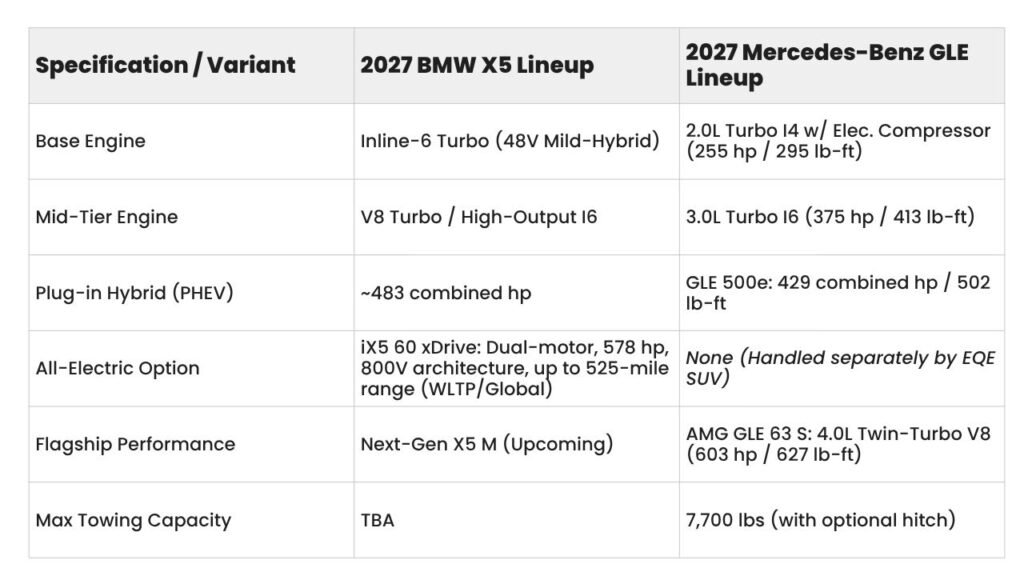
Performance Highlights
- BMW’s EV Powerhouse: The headline for the X5 family is the debut of the all-electric iX5. Utilizing BMW’s 6th-generation eDrive technology and new 120mm tall cylindrical battery cells, it supports ultra-fast 800V charging, bidirectional charging capabilities, and massive driving ranges. For select global markets, BMW will even introduce a hydrogen fuel-cell variant later in the cycle.
- Mercedes’ V8 Commitment: While Mercedes doesn’t offer a pure EV version of the GLE (leaving that to its dedicated EQ platforms), they have doubling down on internal combustion refinement. The GLE 450 gets a massive 44 lb-ft torque bump to 413 lb-ft, while the enthusiast-favorite GLE 580 pushes its twin-turbo V8 to 530 hp. Crucially, that V8 now transitions to a flat-plane-crank setup to offer sharper throttle response while satisfying tightening global emissions standards.
Which One Belongs in Your Driveway?
The 2027 model year has drawn a clear line in the sand between these two German powerhouses.
Choose the 2027 BMW X5 if: You want to feel like you are driving a piece of the future. Its Neue Klasse styling, cutting-edge Panoramic Vision windshield display, and incredibly versatile powertrain options—especially the 800V electric iX5—make it the ultimate choice for tech early-adopters and driving enthusiasts.
Choose the 2027 Mercedes-Benz GLE if: You prefer unapologetic, traditional luxury mixed with maximum screen real estate. With its stunning MBUX Superscreen, massaging hot-stone seats, a roaring flat-plane crank V8 option, and a heavy dose of prestigious branding, the GLE remains the gold standard for effortless, status-driven cruising.